
- Home
- Stephen King
11/22/63 Page 6
11/22/63 Read online
Page 6
"What happens to the diner?"
"The diner's finished, buddy. Even if I was healthy as a horse, it would be gone by the end of this month. You know I always just rented that space, don't you?"
I didn't, but it made sense. Although Worumbo was still called Worumbo, it was now your basic trendy shopping center, so that meant Al had been paying rent to some corporation.
"My lease is up for renewal, and Mill Associates wants that space to put in something called--you're going to love this--an L.L. Bean Express. Besides, they say my little Aluminaire's an eyesore."
"That's ridiculous!" I said, and with such genuine indignation that Al chuckled. The chuckles tried to morph into a coughing fit and he stifled them. Here in the privacy of his own home, he wasn't using tissues, handkerchiefs, or napkins to deal with that cough; there was a box of maxi pads on the table beside his chair. My eyes kept straying to them. I'd urge them away, perhaps to look at the photo on the wall of Al with his arm around a good-looking woman, then find them straying back. Here is one of the great truths of the human condition: when you need Stayfree Maxi Pads to absorb the expectorants produced by your insulted body, you are in serious fucking trouble.
"Thanks for saying that, buddy. We could have a drink on it. My alcohol days are over, but there's iced tea in the fridge. Maybe you'd do the honors."
2
He used sturdy generic glassware at the restaurant, but the pitcher holding the iced tea looked like Waterford to me. A whole lemon bobbed placidly on top, the skin cut to let the flavor seep out. I choked a couple of glasses with ice, poured, and went back into the living room. Al took a long, deep swallow of his and closed his eyes gratefully.
"Boy, is that good. Right this minute everything in Al World is good. That dope's wonderful stuff. Addictive as hell, of course, but wonderful. It even suppresses the coughing a little. The pain'll start creeping in again by midnight, but that should give us enough time to talk this through." He sipped again and gave me a look of rueful amusement. "Human things are terrific right to the end, it seems like. I never would have guessed."
"Al, what happens to that . . . that hole into the past, if they pull your trailer and build an outlet store where it was?"
"I don't know that any more than I know how I can buy the same meat over and over again. What I think is it'll disappear. I think it's as much a freak of nature as Old Faithful, or that weird balancing rock they've got in western Australia, or a river that runs backward at certain phases of the moon. Things like that are delicate, buddy. A little shift in the earth's crust, a change in the temperature, a few sticks of dynamite, and they're gone."
"So you don't think there'll be . . . I don't know . . . some kind of cataclysm?" What I was picturing in my mind was a breach in the cabin of an airliner cruising at thirty-six thousand feet, and everything being sucked out, including the passengers. I saw that in a movie once.
"I don't think so, but who can tell? All I know is that there's nothing I can do about it, either way. Unless you want me to deed the place over to you, that is. I could do that. Then you could go to the National Historical Preservation Society and tell them, 'Hey, guys, you can't let them put up an outlet store in the courtyard of the old Worumbo mill. There's a time tunnel there. I know it's hard to believe, but let me show you.'"
For a moment I actually considered this, because Al was probably right: the fissure leading into the past was almost certainly delicate. For all I knew (or he did), it could pop like a soap bubble if the Aluminaire was even joggled hard. Then I thought of the federal government discovering they could send special ops into the past to change whatever they wanted. I didn't know if that were possible, but if so, the folks who gave us fun stuff like bio-weapons and computer-guided smart bombs were the last folks I'd want carrying their various agendas into living, unarmored history.
The minute this idea occurred to me--no, the very second--I knew what Al had in mind. Only the specifics were missing. I set my iced tea aside and stood up.
"No. Absolutely not. Uh-uh."
He took this calmly. I could say it was because he was stoned on OxyContin, but I knew better. He could see I didn't mean to just walk out no matter what I said. My curiosity (not to mention my fascination) was probably sticking out like porcupine quills. Because part of me did want to know the specifics.
"I see I can skip the introductory material and get right down to business," Al said. "That's good. Sit down, Jake, and I'll let you in on my only reason for not just taking my whole supply of little pink pills at once." And when I stayed on my feet: "You know you want to hear this, and what harm? Even if I could make you do something here in 2011--which I can't--I couldn't make you do anything back there. Once you get back there, Al Templeton's a four-year-old kid in Bloomington, Indiana, racing around his backyard in a Lone Ranger mask and still a bit iffy in the old toilet-training department. So sit down. Like they say in the infomercials, you're under no obligation."
Right. On the other hand, my mother would have said the devil's voice is sweet.
But I sat down.
3
"Do you know the phrase watershed moment, buddy?"
I nodded. You didn't have to be an English teacher to know that one; you didn't even have to be literate. It was one of those annoying linguistic shortcuts that show up on cable TV news shows, day in and day out. Others include connect the dots and at this point in time. The most annoying of all (I have inveighed against it to my clearly bored students time and time and time again) is the totally meaningless some people say, or many people believe.
"Do you know where it comes from? The origin?"
"Nope."
"Cartography. A watershed is an area of land, usually mountains or forests, that drains into a river. History is also a river. Wouldn't you say so?"
"Yes. I suppose I would." I drank some of my tea.
"Sometimes the events that change history are widespread--like heavy, prolonged rains over an entire watershed that can send a river out of its banks. But rivers can flood even on sunny days. All it takes is a heavy, prolonged downpour in one small area of the watershed. There are flash floods in history, too. Want some examples? How about 9/11? Or what about Bush beating Gore in 2000?"
"You can't compare a national election to a flash flood, Al."
"Maybe not most of them, but the 2000 presidential election was in a class by itself. Suppose you could go back to Florida in the fall of Double-O and spend two hundred thousand dollars or so on Al Gore's behalf?"
"Couple of problems with that," I said. "First, I don't have two hundred thousand dollars. Second, I'm a schoolteacher. I can tell you all about Thomas Wolfe's mother fixation, but when it comes to politics I'm a babe in the woods."
He gave an impatient flap of his hand, which almost sent his Marine Corps ring flying off his reduced finger. "Money's not a problem. You'll just have to trust me on that for now. And advance knowledge usually trumps the shit out of experience. The difference in Florida was supposedly less than six hundred votes. Do you think you could buy six hundred votes on Election Day with two hundred grand, if buying was what it came down to?"
"Maybe," I said. "Probably. I guess I'd isolate some communities where there's a lot of apathy and the voting turnout's traditionally light--it wouldn't take all that much research--then go in with the old cashola."
Al grinned, revealing his missing teeth and unhealthy gums. "Why not? It worked in Chicago for years."
The idea of buying the presidency for less than the cost of two Mercedes-Benz sedans silenced me.
"But when it comes to the river of history, the watershed moments most susceptible to change are assassinations--the ones that succeeded and the ones that failed. Archduke Franz Ferdinand of Austria gets shot by a mentally unstable pipsqueak named Gavrilo Princip and there's your kickoff to World War I. On the other hand, after Claus von Stauffenberg failed to kill Hitler in 1944--close, but no cigar--the war continued and millions more died."
I had s
een that movie, too.
Al said, "There's nothing we can do about Archduke Ferdinand or Adolf Hitler. They're out of our reach."
I thought of accusing him of making pronounal assumptions and kept my mouth shut. I felt a little like a man reading a very grim book. A Thomas Hardy novel, say. You know how it's going to end, but instead of spoiling things, that somehow increases your fascination. It's like watching a kid run his electric train faster and faster and waiting for it to derail on one of the curves.
"As for 9/11, if you wanted to fix that one, you'd have to wait around for forty-three years. You'd be pushing eighty, if you made it at all."
Now the lone-star flag the gnome had been holding made sense. It was a souvenir of Al's last jaunt into the past. "You couldn't even make it to '63, could you?"
To this he didn't reply, just watched me. His eyes, which had looked rheumy and vague when he let me into the diner that afternoon, now looked bright. Almost young.
"Because that's what you're talking about, right? Dallas in 1963?"
"That's right," he said. "I had to opt out. But you're not sick, buddy. You're healthy and in the prime of life. You can go back, and you can stop it."
He leaned forward, his eyes not just bright; they were blazing.
"You can change history, Jake. Do you understand that? John Kennedy can live."
4
I know the basics of suspense fiction--I ought to, I've read enough thrillers in my lifetime--and the prime rule is to keep the reader guessing. But if you've gotten any feel for my character at all, based on that day's extraordinary events, you'll know that I wanted to be convinced. Christy Epping had become Christy Thompson (boy meets girl on the AA campus, remember?), and I was a man on his own. We didn't even have any kids to fight over. I had a job I was good at, but if I told you it was challenging, it would be a lie. Hitchhiking around Canada with a buddy after my senior year of college was the closest thing to an adventure I'd ever had, and given the cheerful, helpful nature of most Canadians, it wasn't much of an adventure. Now, all of a sudden, I'd been offered a chance to become a major player not just in American history but in the history of the world. So yes, yes, yes, I wanted to be convinced.
But I was also afraid.
"What if it went wrong?" I drank down the rest of my iced tea in four long swallows, the ice cubes clicking against my teeth. "What if I managed, God knows how, to stop it from happening and made things worse instead of better? What if I came back and discovered America had become a fascist regime? Or that the pollution had gotten so bad everybody was walking around in gas masks?"
"Then you'd go back again," he said. "Back to two minutes of twelve on September ninth of 1958. Cancel the whole thing out. Every trip is the first trip, remember?"
"Sounds good, but what if the changes were so radical your little diner wasn't even there anymore?"
He grinned. "Then you'd have to live your life in the past. But would that be so bad? As an English teacher, you'd still have a marketable skill, and you wouldn't even need it. I was there for four years, Jake, and I made a small fortune. Do you know how?"
I could have taken an educated guess, but I shook my head.
"Betting. I was careful--I didn't want to raise any suspicions, and I sure didn't want some bookie's leg-breakers coming after me--but when you've studied up on who won every big sporting event between the summer of 1958 and the fall of 1963, you can afford to be careful. I won't say you can live like a king, because that's living dangerously. But there's no reason you can't live well. And I think the diner'll still be there. It has been for me, and I changed plenty of things. Anybody does. Just walking around the block to buy a loaf of bread and a quart of milk changes the future. Ever hear of the butterfly effect? It's a fancy-shmancy scientific theory that basically boils down to the idea that--"
He started coughing again, the first protracted fit since he'd let me in. He grabbed one of the maxis from the box, plastered it across his mouth like a gag, and then doubled over. Gruesome retching sounds came up from his chest. It sounded as if half his works had come loose and were slamming around in there like bumper cars at an amusement park. Finally it abated. He glanced at the pad, winced, folded it up, and threw it away.
"Sorry, buddy. This oral menstruation's a bitch."
"Jesus, Al!"
He shrugged. "If you can't joke about it, what's the point of anything? Now where was I?"
"Butterfly effect."
"Right. It means small events can have large, whatchamadingit, ramifications. The idea is that if some guy kills a butterfly in China, maybe forty years later--or four hundred--there's an earthquake in Peru. That sound as crazy to you as it does to me?"
It did, but I remembered a hoary old time-travel paradox and pulled it out. "Yeah, but what if you went back and killed your own grandfather?"
He stared at me, baffled. "Why the fuck would you do that?"
That was a good question, so I just told him to go on.
"You changed the past this afternoon in all sorts of little ways, just by walking into the Kennebec Fruit . . . but the stairs leading up into the pantry and back into 2011 were still there, weren't they? And The Falls is the same as when you left it."
"So it seems, yes. But you're talking about something a little more major. To wit, saving JFK's life."
"Oh, I'm talking about a lot more than that, because this ain't some butterfly in China, buddy. I'm also talking about saving RFK's life, because if John lives in Dallas, Robert probably doesn't run for president in 1968. The country wouldn't have been ready to replace one Kennedy with another."
"You don't know that for sure."
"No, but listen. Do you think that if you save John Kennedy's life, his brother Robert is still at the Ambassador Hotel at twelve-fifteen in the morning on June fifth, 1968? And even if he is, is Sirhan Sirhan still working in the kitchen?"
Maybe, but the chances had to be awfully small. If you introduced a million variables into an equation, of course the answer was going to change.
"Or what about Martin Luther King? Is he still in Memphis in April of '68? Even if he is, is he still standing on the balcony of the Lorraine Motel at exactly the right time for James Earl Ray to shoot him? What do you think?"
"If that butterfly theory is right, probably not."
"That's what I think, too. And if MLK lives, the race riots that followed his death don't happen. Maybe Fred Hampton doesn't get shot in Chicago."
"Who?"
He ignored me. "For that matter, maybe there's no Symbionese Liberation Army. No SLA, no Patty Hearst kidnapping. No Patty Hearst kidnapping, a small but maybe significant reduction in black fear among middle-class whites."
"You're losing me. Remember, I was an English major."
"I'm losing you because you know more about the Civil War in the nineteenth century than you do about the one that ripped this country apart after the Kennedy assassination in Dallas. If I asked you who starred in The Graduate, I'm sure you could tell me. But if I asked you to tell me who Lee Oswald tried to assassinate only a few months before gunning Kennedy down, you'd go 'Huh?' Because somehow all that stuff has gotten lost."
"Oswald tried to kill someone before Kennedy?" This was news to me, but most of my knowledge of the Kennedy assassination came from an Oliver Stone movie. In any case, Al didn't answer. Al was on a roll.
"Or what about Vietnam? Johnson was the one who started all the insane escalation. Kennedy was a cold warrior, no doubt about it, but Johnson took it to the next level. He had the same my-balls-are-bigger-than-yours complex that Dubya showed off when he stood in front of the cameras and said 'Bring it on.' Kennedy might have changed his mind. Johnson and Nixon were incapable of that. Thanks to them, we lost almost sixty thousand American soldiers in Nam. The Vietnamese, North and South, lost millions. Is the butcher's bill that high if Kennedy doesn't die in Dallas?"
"I don't know. And neither do you, Al."
"That's true, but I've become quite the student of
recent American history, and I think the chances of improving things by saving him are very good. And really, there's no downside. If things turn to shit, you just take it all back. Easy as erasing a dirty word off a chalkboard."
"Or I can't get back, in which case I never know."
"Bullshit. You're young. As long as you don't get run over by a taxicab or have a heart attack, you'd live long enough to know how things turn out."
I sat silent, looking down at my lap and thinking. Al let me. At last I raised my head again.
"You must have read a lot about the assassination and about Oswald."
"Everything I could get my hands on, buddy."
"How sure are you that he did it? Because there are about a thousand conspiracy theories. Even I know that. What if I went back and stopped him and some other guy popped Kennedy from the Grassy Hill, or whatever it was?"
"Grassy Knoll. And I'm close to positive it was all Oswald. The conspiracy theories were all pretty crazy to begin with, and most of them have been disproved over the years. The idea that the shooter wasn't Oswald at all, but someone who looked like him, for instance. The body was exhumed in 1981 and DNA tested. It was him, all right. The poisonous little fuck." He paused, then added: "I met him, you know."
I stared at him. "Bullshit!"
"Oh yes. He spoke to me. This was in Fort Worth. He and Marina--his wife, she was Russian--were visiting Oswald's brother in Fort Worth. If Lee ever loved anybody, it was his brother Bobby. I was standing outside the picket fence around Bobby Oswald's yard, leaning against a phone pole, smoking a cigarette and pretending to read the paper. My heart was hammering what felt like two hundred beats a minute. Lee and Marina came out together. She was carrying their daughter, June. Just a mite of a thing, less than a year old. The kid was asleep. Ozzie was wearing khaki pants and a button-down Ivy League shirt that was all frayed around the collar. The slacks had a sharp crease, but they were dirty. He'd given up his Marine cut, but his hair would still have been way too short to grab. Marina--holy Christ, what a knockout! Dark hair, bright blue eyes, flawless skin. She looks like a goddam movie star. If you do this, you'll see for yourself. She said something to him in Russian as they came down the walk. He said something back. He was smiling when he said it, but then he pushed her. She almost fell over. The kid woke up and started to cry. All this time, Oswald kept smiling."
 The Stand
 The Shining
 It
It The Dead Zone
 The Dark Tower
 The Gunslinger
 Song of Susannah
 Under the Dome
 The Mist
 Revival
 Misery
 Mile 81
 From a Buick 8
 Just After Sunset
 Black House
 Doctor Sleep
 The Drawing of the Three
 Wizard and Glass
 Dolores Claiborne
 Carrie
 The Little Sisters of Eluria
 The Waste Lands
 The Green Mile
 The Girl Who Loved Tom Gordon
 Cujo
Cujo The Outsider_A Novel
 The Tommyknockers
 Cell
Cell Pet Sematary
 The Talisman
 Four Past Midnight
 Different Seasons
 Needful Things
 Nightmares and Dreamscapes
 Christine
 The Running Man
 The Eyes of the Dragon
 11/22/63
 Firestarter
 Insomnia
 Finders Keepers
 Gerald's Game
 The Wind Through the Keyhole
 Hearts in Atlantis
 Danse Macabre
 Thinner
 Duma Key
 The Bachman Books
 Skeleton Crew
 The Outsider-Stephen King
 Full Dark, No Stars
 Salem's Lot
 Bag of Bones
 Desperation
 End of Watch
 Wolves of the Calla
 Mr. Mercedes
 Billy Summers
 Rose Madder
 Later
Later Gunslinger
 The Langoliers
 Joyland
 If It Bleeds
 Apt Pupil (Scribner Edition)
 Flight or Fright
 Everything's Eventual: 14 Dark Tales
 Night Shift
 The Dark Half
 On Writing
 The Institute
 A Death
 The Man in the Black Suit : 4 Dark Tales
 Bullet
 The Dark Tower tdt-7
 Chiral Mad 3
 Big Driver
 Stephen King: The Green Mile
 Dolan's Cadillac nad-1
 Head Down nad-22
 The Doctor's Case
 Luckey Quarter
 Rage (richard bachman)
 Black House js-2
 The Wind Through the Keyhole (Dark Tower)
 Duma Key: A Novel
 Dark Tower V, The
 Cycle of the Werewolf
 AUTOPSY ROOM FOUR
 Dark Tower VII, The (v. 7)
 Gramma
 Suffer the Little Children
 Chinga
 Word Processor of the Gods
 Lisey’sStory
 Dark Tower V (Prologue)
 The Stand (Original Edition)
 Rainy Season nad-13
 Transgressions
 The Plant
 Under the Dome: A Novel
 The Dark Tower II: The Drawing of the Three
 The End of the Whole Mess:
 Ur
Ur The Body
 Uncollected Stories 2003
 Chattery Teeth
 The Mouse on the Mile
 The Cat from Hell
![The Drawing of the Three [The Dark Tower II] Read online](http://i1.bookreadfree.com/i/03/25/the_drawing_of_the_three_the_dark_tower_ii_preview.jpg) The Drawing of the Three [The Dark Tower II]
The Drawing of the Three [The Dark Tower II] Cell: A Novel
 Uncle Otto's Truck
 Song of Susannah dt-6
 The Dark Tower VII
 Head Down
 Sneakers
 Crouch End
 Outsider
 End of Watch: A Novel (The Bill Hodges Trilogy Book 3)
 Revival: A Novel
 Everything's Eventual skssc-4
 The Colorado Kid
 Sleeping Beauties: A Novel
 The Dark Tower IV Wizard and Glass
 A Book of Horrors
 Four Past Midnight - 3 - Secret Window, Secret Garden
 The House on Maple Street
 Sometimes They Come Back
 Blockade Billy
 Crouch End nad-17
 Lunch at the Gotham Cafe
 The Waste Lands dt-3
 Six Stories
 A Face in the Crowd
 Case
Case Four Past Midnight - 2 - The Langoliers
 Umney's last case nad-21
 Survivor Type
 Guns (Kindle Single)
 You Know They Got a Hell of a Band
 The Jaunt
 In A Half World Of Terror
 Gwendy's Button Box
 Storm of the Century
 The Jaunt. Travel
 Roadwork
 Darktower 1 - The Gunslinger
 Faithful
 The Regulators
 A Bedroom in the Wee Hours of the Morning
 Graveyard Shift
 The Monkey
 Children of the Corn
 The Reploids
 1922
1922 Darktower 2 - The Drawing of the Three
 Wizard and Glass dt-4
 Riding The Bullet
 Wolves of the Calla dt-5
 L.T.'S Theory Of Pets
 The Langoliers fpm-1
 The Two Dead Girls
 The Blue Air Compressor
 Everything's Eventual
 You, Human: An Anthology of Dark Science Fiction
 The Night of The Tiger
 The Regulators (richard bachman)
 Elevation
 The Road Virus Heads North
 Good Marriage
 Four Past Midnight - 5 - The Library Policeman
 Grey Matter
 Herman Wouk Is Still Alive
 In the Tall Grass
 Six Scary Stories
 Foreward
 The Crate
 The wind through the keyhole adt-8
 King, Stephen - Battleground
 The Wedding Gig
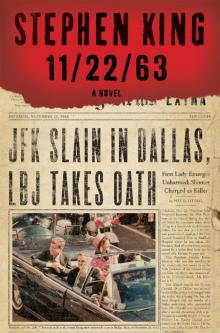 11/22/63: A Novel
 The Long Walk