
- Home
- Stephen King
Danse Macabre Page 43
Danse Macabre Read online
Page 43
A group of toddlers watched her pass, their eyes painted into their sockets. On the ground floor, red and pink and yellow hands on stalks reached for her from the glove counter. Blind mauve faces craned on necks as long as arms; wigs roosted on their heads.
. . . The bald man was still staring at her. His head, which looked perched on top of a bookcase, shone like plastic beneath the fluorescent lights. His eyes were bright, flat, expressionless as glass; she thought of a display head stripped of its wig. When a fat pink tongue squeezed out between his lips, it was as if a plastic head had come to life.
Good stuff. But strange; so uniquely Campbell that it might as well be trademarked. Good horror novels are not a dime a dozen--by no means--but there never seems to be any serious shortage of good ones, either. And by that I mean that you seem to be able to count on a really good novel of horror and/or the supernatural (or at least a really interesting one) every year or so--and much the same could be said for the horror films. A vintage year may produce as many as three amid the paperback-original dreck about hateful, paranormal children and presidential candidates from hell and the too-large collection of hardcover boners, such as the recent Virgin, by James Petersen. But, maybe paradoxically, maybe not, good horror writers are quite rare . . . and Campbell is better than just good.
That's one reason fans of the genre will greet The Parasite with such pleasure and relief; it is even better than his first novel, of which I want to treat briefly here. Campbell has been turning out his own patented brand of short horror tale for some years now (like Bradbury and Robert Bloch, Arkham House published Ramsey Campbell's first book, The Inhabitant of the Lake, which was a Lovecraft clone). Several collections of his stories are available, the best of them probably being The Height of the Scream. A story you will not find in that book, unfortunately, is "The Companion," in which a lonely man who tours "funfairs" on his holidays encounters a horror beyond my ability to describe while riding a Ghost Train into its tunnel. "The Companion" may be the best horror tale to be written in English in the last thirty years; it is surely one of half a dozen or so which will still be in print and commonly read a hundred years from now. Campbell is literate in a field which has attracted too many comic-book intellects, cool in a field where too many writers--myself included--tend toward panting melodrama, fluid in a field where many of the best practitioners often fall prey to cant and stupid "rules" of fantasy composition.
But not all good short-story writers in this field are able to make the jump to the novel (Poe tried with The Narrative of Arthur Gordon Pym and made a conditional success of the job; Lovecraft failed ambitiously twice, with The Strange Case of Charles Dexter Ward and the rather more interesting At the Mountains of Madness, whose plot is remarkably Pym-like). Campbell made the jump almost effortlessly, with a novel as good as its title was off-putting: The Doll Who Ate His Mother. The book was published with absolutely no fanfare in 1977 in hardcover, and then with an even greater lack of fanfare a year later in paperback . . . one of those cases that make a writer wonder if publishers don't practice their own sort of voodoo, singling certain books out to be ritually slaughtered in the marketplace.
Well, never mind that. Concerning the jump from the short story to the novel--writing the latter is much like long-distance running, and you can almost feel some would-be novelists getting tired. You sense they're starting to breathe a trifle hard by page one hundred, to puff and blow by page two hundred, and to finally limp over the finish line with little to recommend them beyond the bare fact that they have finished. But Campbell runs well.
He is personally an amusing, even a jolly man (at the 1979 World Fantasy Convention he presented Stephen R. Donaldson with the British Fantasy Award, a modernistic little statuette, for his Thomas Covenant trilogy; Campbell, in that marvelously broad and calm Liverpool accent, referred to it as "the skeletal dildo." The audience broke up, and someone at my table marveled, "He sounds just like one of the Beatles."). As with Robert Bloch, the last thing you would suspect is that he is a writer of horror fiction, particularly of the grim brand he turns out. Of The Doll Who Ate His Mother he has this to say--some of it bearing directly on the difference in the amount of endurance needed to do a novel: "What I wanted to do with The Doll was to invent a new monster, if that is possible, but perhaps the big thing was to actually write the novel, since previously I'd been doing short stories. In 1961 or '62 I made notes for a story about a black magician who was going to take revenge on his town or village for some real or imagined wrong it had done him. He was going to do this by using voodoo dolls to deform the babies--you'd have the standard pulp-magazine scene of the white-faced doctor coming out of the delivery room saying, 'My God, it's not human . . . ! ' And the twist was going to be that, after all these deformed infants had died, the black magician would use the voodoo dolls to bring them back to life. An amazingly tasteless idea. At about the same time the Thalidomide tragedy occurred, making the story idea a little too 'topically tasteless' for me, and I dropped it.
"It resurfaced, I suppose, in The Doll Who Ate His Mother, which eats its way out of its mother's womb.
"How does writing novels differ from writing short stories? I think a novel gathers its own impetus. I have to creep up on it unawares, thinking to myself, 'Maybe I'll start it next week, maybe I'll start it next month.' Then one day I sat down, began to write, and looked up at noon, thinking: 'My God! I've started a novel! I don't believe it!'
"Kirby [McCauley] said, when I asked him how long the novel should be, that 70,000 words or so would be about right, and I took him almost literally. When I got up around the 63,000 word mark, I thought: 'Only 7,000 words left--time to wrap this up.' That's why many of the later chapters seem terse."
Campbell's novel begins with Clare Frayn's brother Rob losing an arm and his life in a Liverpool car accident. The arm, torn off in the accident, is important because somebody makes off with it . . . and eats it. This muncher of arms, we are led to suppose, is a shadowy young man named Chris Kelly. Clare--who embodies many of the ideas already labeled as "new American gothic" (sure, Campbell is British, but many of his influences--both literary and cinematic--are American)--meets a crime reporter named Edmund Hall who believes that the man who caused Rob Frayn's death was the grown-up version of a boy he knew in school, a boy fascinated with death and cannibalism. In dealing with archetypes, I've not suggested that we deal out a Tarot card for the Ghoul, one of the more grisly creatures in monsterdom, believing that the eating of dead flesh and the drinking of blood are really parts of the same archetype.22 Is there really such a thing as a "new monster"? In light of the genre's strictness, I think not, and Campbell must be content instead with a fresh perspective . . . no mean feat in itself. In Chris Kelly I believe the face we see is that of our old friend the Vampire . . . as we see it in a movie which resembles Campbell's novel by turns, the brilliant Canadian director David Cronenberg's They Came from Within.
Clare, Edmund Hall, and George Pugh, a cinema owner whose elderly mother has also been victimized by Kelly, join together in a strange and reluctant three-way partnership to track this supernatural cannibal down. Here again we feel echoes of the classic tale of the Vampire, Stoker's Dracula. And perhaps we never feel the changes of the nearly eighty years which lie between the two books so strongly as we do in the contrast between the group of six which forms to track down Count Dracula and the group of three which forms to track down "Chris Kelly." There is no sense of self-righteousness in Clare, Edmund, and George--they are truly little people, afraid, confused, often depressed; they turn inward to themselves rather than outward toward each other, and while we sense their fright very strongly, there is no feeling about the book that Clare, Edmund, and George must prevail because their cause is just. They somehow symbolize the glum and rather drab place England has become in the second half of the twentieth century, and we feel that if some or all of them do muddle through, it will be due more to impersonal luck than to any action of their own.
And the three of them do track Kelly down . . . after a fashion. The climax of the hunt takes place in the rotting cellar of a slum building marked for demolition, and here Campbell has created one of the dreamiest and most effective sequences in all of modern horror fiction. In its surreal and nightmarish evocation of ancient evil, in the glimpses it gives us of "absolute power," it is finally a voice from the latter part of the twentieth century which speaks powerfully in the language which Lovecraft can be said to have invented. Here is nothing so pallid or so imitative as a Lovecraft "pastiche," but a viable, believable version of those Lovecraftian Elder Gods that so haunted Dunwich, Arkham, Providence, Central Falls . . . and the pages of Weird Tales magazine.
Campbell is good, if rather unsympathetic, with character (his lack of emotion has the effect of chilling his prose even further, and some readers will be put off by the tone of this novel; they may feel that Campbell has not so much written a novel as grown one in a Petrie dish): Clare Frayn with her stumpy legs and her dreams of grace, Edmund with his baleful thoughts of glory yet to come, and best of all, because here Campbell does seem to kindle real feelings of emotion and kindliness, George Pugh holding on to the last of his cinemas and scolding two teenage girls who walk out before the playing of the National Anthem has finished.
But perhaps the central character here is Liverpool itself, with its orange sodium lights, its slums and docks, its cinemas converted into HALF A MILE OF FURNITURE. Campbell's short stories live and breathe Liverpool in what seems to be equal amounts of attraction and repulsion, and that sense of place is one of the most remarkable things about The Doll as well. This locale is as richly textured as Raymond Chandler's Los Angeles of the forties and fifties or Larry McMurtry's Houston of the sixties. "Children were playing ball against the church," Campbell writes. "Christ held up His arms for a catch." It is a small line, understated and almost thrown away (like all those creepy, reaching gloves in The Parasite), but this sort of thing is cumulative, and at least suggests Campbell's commitment to the idea that horror exists in point of view as well as in incident.
The Doll Who Ate His Mother is not the greatest of the novels discussed here--I suppose that would have to be either The Haunting of Hill House or Straub's Ghost Story--and it is not as good as Campbell's The Parasite . . . but it is remarkably good. Campbell keeps a tight rein on his potentially tabloid-style material, even playing off it occasionally (a dull and almost viciously insensitive teacher sits in the faculty room of his school reading a paper with a headline which blares HE CUT UP YOUNG VIRGINS AND LAUGHED--the story's blackly hilarious subhead informs us that His Potency Came From Not Having Orgasms). He carries us inexorably past levels of abnormal psychology into something that is much, much worse.
Campbell is extremely conscious of his literary roots--he mentions Lovecraft (adding "of course" almost unconsciously), Robert Bloch (he compares The Doll's climax in the abandoned cellar to the climax of Psycho, where Lila Crane must face Norman Bates's "mother" in a similar basement), and Fritz Leiber's stories of urban horror (such as "Smoke Ghost") and more notably, Leiber's eerie novel of San Francisco, Our Lady of Darkness (winner of the Best Novel award at the 1978 World Fantasy Convention). In Our Lady of Darkness, Leiber adopts as his thesis the idea that when a city becomes complex enough, it may take on a tenebrous life of its own, quite apart from the lives of the people who live and work there--an evil sentience linked, in some unstated way, to the Elder Ones of Lovecraft and, more importantly in terms of the Leiber novel, Clark Ashton Smith. Amusingly, one of the characters in Our Lady of Darkness suggests that San Francisco did not become truly sentient until the Transamerica Pyramid was finished and occupied.
While Campbell's Liverpool does not have this kind of conscious evil life, the picture he draws of it gives the reader the feeling that he is observing a slumbering, semisentient monster that might awake at any moment. His debt to Leiber seems clearer here than that to Lovecraft, in fact. Either way, Ramsey Campbell has succeeded in forging something uniquely his own in The Doll Who Ate His Mother.
James Herbert, on the other hand, comes from an older tradition--the same sort of pulp horror-fiction that we associate with writers such as Robert E. Howard, Seabury Quinn, the early Sturgeon, the early Henry Kuttner, and, on the English side of the Atlantic, Guy N. Smith. Smith, the author of paperback originals beyond counting, has written a novel whose title is my nominee for the all-time pulp horror classic: The Sucking Pit.
This sounds as if I were getting ready to knock Herbert, but this isn't the case. It's true that he is held in remarkably low esteem by writers in the genre on both sides of the Atlantic; when I've mentioned his name in the past, noses have automatically wrinkled (it's a little like ringing a bell in order to watch conditioned dogs salivate), but when you inquire more closely, you find that remarkably few people in the field have actually read Herbert--and the fact is that James Herbert is probably the best writer of pulp horror to come along since the death of Robert E. Howard, and I believe that Conan's creator would have responded to Herbert's work with immediate enthusiasm, although the two men were opposites in many ways. Howard was big and broad shouldered; the face in those pictures which remain to us is expressionless with, we might think, undertones of either shyness or suspicion. James Herbert is of medium height, slim, quick to smile or frown, open and frank. Of course the biggest difference may be that Howard is dead and Herbert ain't, ha-ha.
Howard's best work--his stories of Conan the Barbarian--are in the mythic country of Cimmeria, far in a similarly mythic past inhabited by monsters and beautiful, sexy maidens in need of rescue. And Conan will be happy to effect said rescue . . . if the price is right. Herbert's work is set firmly in England's present, most commonly against the backdrop of London or the southern counties which surround it. Howard was brought up in rural circumstances (he lived and died in a small sagebrush town called Cross Plains, Texas); Herbert was born in London's East End, the son of street traders, and his work reflects a checkered career as a rock and roll singer, artist, and ad executive.
It is in the elusive matter of style--a confusing word that may be most accurately defined as "plan or method of attack"--that Herbert strongly recalls the Howard that was. In his novels of horror--The Rats, The Fog, The Survivor, The Spear, The Lair, and The Dark--Herbert does not just write; as Robert E. Howard did, he puts on his combat boots and goes out to assault the reader with horror.
Let me also take a moment to point out one similarity that James Herbert and Ramsey Campbell do share, simply by virtue of their Englishness: they both write that clear, lucid, grammatical prose that only those educated in England seem able to produce. You'd think that the ability to write lucid prose would be the bottom line for any publishing novelist, but it is not so. If you don't believe me, go check out the paperback originals rack at your local bookstore. I promise you such a carnival of dangling participles, misplaced modifiers, and even lack of agreement between subject and verb that your hair may turn white. You would expect that proofreaders and copy editors would pick this sort of stuff up even if the writers of such embarrassing English do not, but many of them seem as illiterate as the writers they are trying to bail out.
Worse than the mechanical errors, many writers of fiction seem totally unable to explain simple operations or actions clearly enough for the reader to be able to see them in his or her mind's eye. Some of this is a failure on the writer's part to visualize well and completely; his or her own mind's eye seems bleared half-shut. More of it is a simple failure of that most basic writer's tool, the working vocabulary. If you're writing a haunted-house story and you don't know the difference between a gable and a gambrel, a cupola and a turret, paneling and wain-scotting, you, sir or madam, are in trouble.
Now don't get me wrong here; I thought Edwin Newman's book on the degeneration of the English language was moderately entertaining but also often tiresome and amazingly prissy, the book of a man who would like to put language inside a hermetically seale
d bell-jar (like a carefully groomed corpse inside a glass coffin) instead of sending it out into the streets to jive with the people. But language has its own point and reason for being. Parapsychologists may argue over extrasensory perception; psychologists and neurologists may claim there is no such thing; but those who love books and love the language know that the printed word really is a kind of telepathy. In most cases the writer does her or his work silently, couching thoughts in symbols composed of letters in groups set off one from the next by white space, and in most cases the reader does her or his work silently, reading the symbols and reintegrating them as thoughts and images. Louis Zukofsky, the poet (A, among other books), claimed that even the look of words on the page--the indents, the punctuation, the place on the line where the paragraph ends--has its own story to tell. "Prose," Zukofsky said, "is poetry."
It's probably true that the writer's thoughts and the reader's thoughts never tally exactly, that the image the writer sees and the image the reader sees are never 100 percent the same. We are, after all, not angels but were made a little less than the angels, and our language is maddeningly hobbled, a fact to which any poet or novelist will attest. There is no creative writer, I think, who has not suffered that frustrating crash off the walls which stand at the limits of language, who has not cursed the word that just doesn't exist. Emotions such as grief and romantic love are particularly hard to deal with, but even such a simple operation as starting up a car with a manual transmission and driving it to the end of the block can present nearly insurmountable problems if you try to write the process down instead of simply doing it. And if you don't believe this is so, write down such instructions and try them on a nondriving friend . . . but check your auto insurance policy first.
 The Stand
 The Shining
 It
It The Dead Zone
 The Dark Tower
 The Gunslinger
 Song of Susannah
 Under the Dome
 The Mist
 Revival
 Misery
 Mile 81
 From a Buick 8
 Just After Sunset
 Black House
 Doctor Sleep
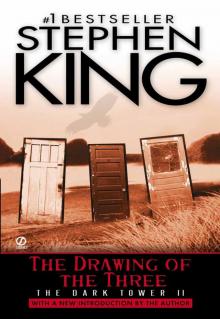 The Drawing of the Three
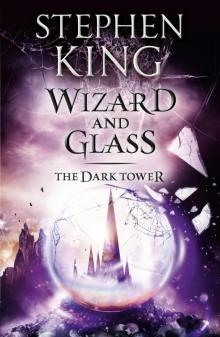 Wizard and Glass
 Dolores Claiborne
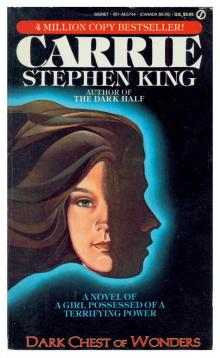 Carrie
 The Little Sisters of Eluria
 The Waste Lands
 The Green Mile
 The Girl Who Loved Tom Gordon
 Cujo
Cujo The Outsider_A Novel
 The Tommyknockers
 Cell
Cell Pet Sematary
 The Talisman
 Four Past Midnight
 Different Seasons
 Needful Things
 Nightmares and Dreamscapes
 Christine
 The Running Man
 The Eyes of the Dragon
 11/22/63
 Firestarter
 Insomnia
 Finders Keepers
 Gerald's Game
 The Wind Through the Keyhole
 Hearts in Atlantis
 Danse Macabre
 Thinner
 Duma Key
 The Bachman Books
 Skeleton Crew
 The Outsider-Stephen King
 Full Dark, No Stars
 Salem's Lot
 Bag of Bones
 Desperation
 End of Watch
 Wolves of the Calla
 Mr. Mercedes
 Billy Summers
 Rose Madder
 Later
Later Gunslinger
 The Langoliers
 Joyland
 If It Bleeds
 Apt Pupil (Scribner Edition)
 Flight or Fright
 Everything's Eventual: 14 Dark Tales
 Night Shift
 The Dark Half
 On Writing
 The Institute
 A Death
 The Man in the Black Suit : 4 Dark Tales
 Bullet
 The Dark Tower tdt-7
 Chiral Mad 3
 Big Driver
 Stephen King: The Green Mile
 Dolan's Cadillac nad-1
 Head Down nad-22
 The Doctor's Case
 Luckey Quarter
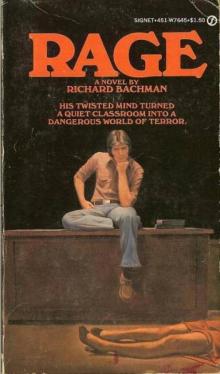 Rage (richard bachman)
 Black House js-2
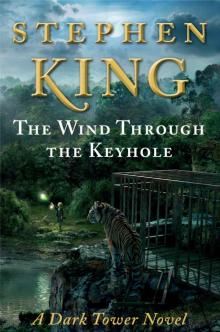 The Wind Through the Keyhole (Dark Tower)
 Duma Key: A Novel
 Dark Tower V, The
 Cycle of the Werewolf
 AUTOPSY ROOM FOUR
 Dark Tower VII, The (v. 7)
 Gramma
 Suffer the Little Children
 Chinga
 Word Processor of the Gods
 Lisey’sStory
 Dark Tower V (Prologue)
 The Stand (Original Edition)
 Rainy Season nad-13
 Transgressions
 The Plant
 Under the Dome: A Novel
 The Dark Tower II: The Drawing of the Three
 The End of the Whole Mess:
 Ur
Ur The Body
 Uncollected Stories 2003
 Chattery Teeth
 The Mouse on the Mile
 The Cat from Hell
![The Drawing of the Three [The Dark Tower II] Read online](http://i1.bookreadfree.com/i/03/25/the_drawing_of_the_three_the_dark_tower_ii_preview.jpg) The Drawing of the Three [The Dark Tower II]
The Drawing of the Three [The Dark Tower II] Cell: A Novel
 Uncle Otto's Truck
 Song of Susannah dt-6
 The Dark Tower VII
 Head Down
 Sneakers
 Crouch End
 Outsider
 End of Watch: A Novel (The Bill Hodges Trilogy Book 3)
 Revival: A Novel
 Everything's Eventual skssc-4
 The Colorado Kid
 Sleeping Beauties: A Novel
 The Dark Tower IV Wizard and Glass
 A Book of Horrors
 Four Past Midnight - 3 - Secret Window, Secret Garden
 The House on Maple Street
 Sometimes They Come Back
 Blockade Billy
 Crouch End nad-17
 Lunch at the Gotham Cafe
 The Waste Lands dt-3
 Six Stories
 A Face in the Crowd
 Case
Case Four Past Midnight - 2 - The Langoliers
 Umney's last case nad-21
 Survivor Type
 Guns (Kindle Single)
 You Know They Got a Hell of a Band
 The Jaunt
 In A Half World Of Terror
 Gwendy's Button Box
 Storm of the Century
 The Jaunt. Travel
 Roadwork
 Darktower 1 - The Gunslinger
 Faithful
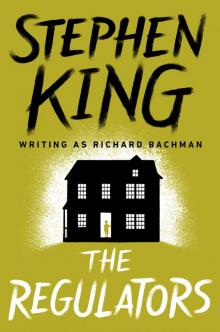 The Regulators
 A Bedroom in the Wee Hours of the Morning
 Graveyard Shift
 The Monkey
 Children of the Corn
 The Reploids
 1922
1922 Darktower 2 - The Drawing of the Three
 Wizard and Glass dt-4
 Riding The Bullet
 Wolves of the Calla dt-5
 L.T.'S Theory Of Pets
 The Langoliers fpm-1
 The Two Dead Girls
 The Blue Air Compressor
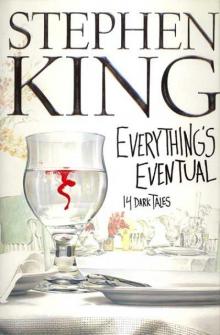 Everything's Eventual
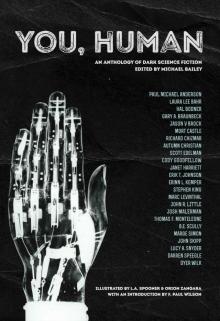 You, Human: An Anthology of Dark Science Fiction
 The Night of The Tiger
 The Regulators (richard bachman)
 Elevation
 The Road Virus Heads North
 Good Marriage
 Four Past Midnight - 5 - The Library Policeman
 Grey Matter
 Herman Wouk Is Still Alive
 In the Tall Grass
 Six Scary Stories
 Foreward
 The Crate
 The wind through the keyhole adt-8
 King, Stephen - Battleground
 The Wedding Gig
 11/22/63: A Novel
 The Long Walk